Health-related conspiracy theories have become one of the most significant challenges facing contemporary societies, affecting public trust in science, healthcare institutions and democratic decision-making. From misinformation about vaccines and medical treatments to broader narratives questioning the legitimacy of scientific authorities, conspiracy beliefs can influence individual behaviours, undermine public health initiatives and deepen social divisions. The COVID-19 pandemic marked a turning point, revealing how rapidly these narratives can spread and how closely they are connected to uncertainty, institutional distrust and wider social vulnerabilities.
But how can health-related conspiracy theories be effectively countered? Are fact-checking and scientific communication sufficient to challenge deeply rooted beliefs? And what strategies can help prevent misinformation from taking hold while strengthening trust between citizens, scientific communities and public institutions?
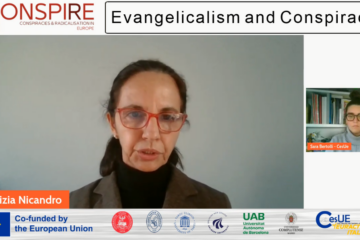
These questions are explored in an interview with Laia García Muñoz, sociologist and research assistant at the Universitat Autònoma de Barcelona, conducted by Sara Bertolli, journalist at Focus Europe Italia, within the framework of the European project CONSPIRE – CONSPIracism and RAdicalisation Risks in Europe.
Funded by the Erasmus+ programme and coordinated by the University of Turin, CONSPIRE brings together European universities and CESUE/Focus Europe.